dSUNO for Cardiac MRI
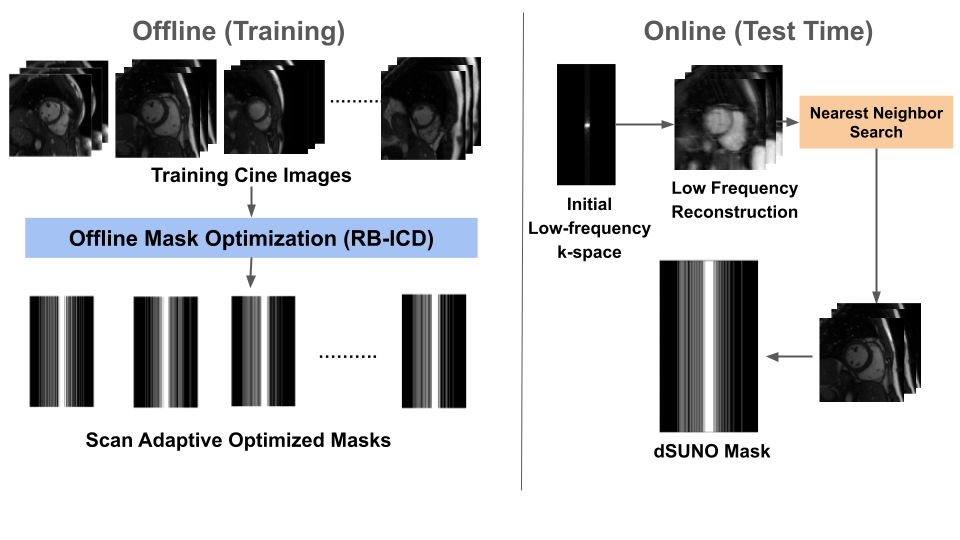
Cardiac cine MRI is limited by long acquisition times, increasing discomfort and motion sensitivity. We accelerate Cartesian dynamic cardiac MRI by learning scan-/slice-adaptive undersampling masks tailored to each scan. Using fully sampled training time-series data, we optimize undersampling patterns offline and store them in a dictionary. At inference, we use a nearest-neighbor search in low-frequency k-space to select an optimized mask, which is then applied across the entire dynamic series. Across public and in-house cardiac datasets, dSUNO improves reconstruction quality over common baselines, achieving ~2–3 dB PSNR gains, lower NMSE, higher SSIM, and better radiologist ratings, supporting improved diagnostic quality at higher accelerations.
Code here
References
S. Gautam, A. Li, P. P. Agarwal, A. K. Attili, J. A. Fessler, N. Seiberlich, and S. Ravishankar, " Scan-Adaptive Dynamic MRI Undersampling Using a Dictionary of Efficiently Learned Patterns ," arXiv preprint arXiv:2602.13984, 2026.
SUNO for Static MRI
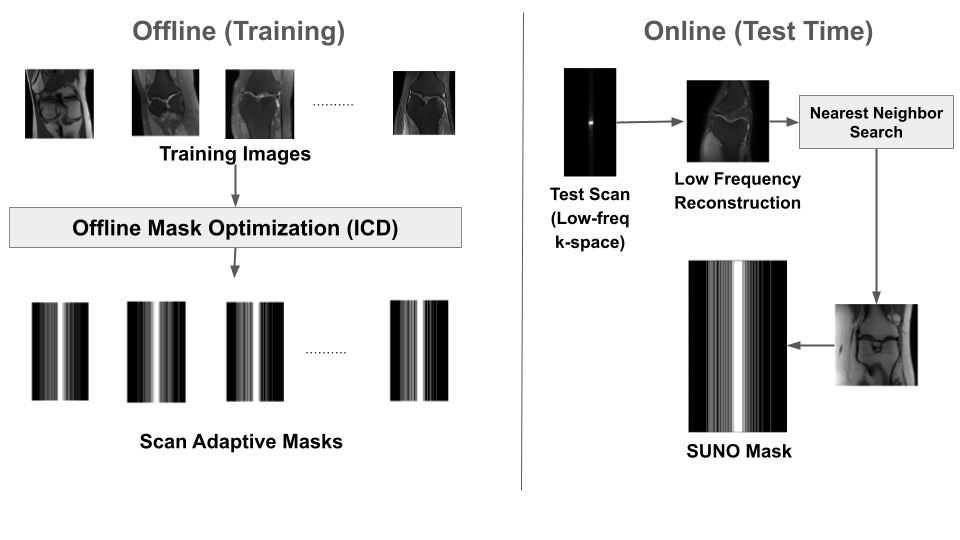
Accelerated MRI often relies on k-space undersampling with advanced reconstruction, and recent work has learned population-adaptive sampling patterns from groups of scans. We go a step further by personalizing sampling per scan. We propose a framework that jointly learns scan-adaptive Cartesian undersampling patterns and a corresponding reconstruction model from training data. The method alternates between learning the reconstructor and offline ICD-based optimization of scan-specific k-space masks. At test time, a nearest-neighbor search using initially acquired low-frequency k-space selects an optimized mask from a learned dictionary. On fastMRI multi-coil knee and brain data, SUNO improves reconstruction quality at 4x and 8x.
Code here
References
S. Gautam, A. Li, N. Seiberlich, J. A. Fessler, and S. Ravishankar, " Scan-Adaptive MRI Undersampling Using Neighbor-based Optimization (SUNO) ," IEEE Transactions on Computational Imaging, 2026.
S. Gautam, A. Li, and S. Ravishankar, " Patient-Adaptive and Learned MRI Data Undersampling Using Neighborhood Clustering ," ICASSP 2024 – IEEE International Conference on Acoustics, Speech and Signal Processing, Seoul, Republic of Korea, 2024, pp. 2081–2085.
M-Net for Joint Optimization of Sampling and Reconstruction
Magnetic resonance imaging (MRI) is essential for the detection and diagnosis of diseases. MRI scanners sequentially collect measurements in the frequency domain (or k-space), from which an image is reconstructed. A central challenge in MRI is its time-consuming sequential acquisition process as the scanner needs to densely sample the underlying k-space for accurate reconstruction. In order to improve patients’ comfort & safety and alleviate motion artifacts, reconstructing high-quality images from limited measurements is desirable. There are two core parts in the accelerated MRI pipeline: a sampling pattern deployed to collect the undersampled data in k-space and a corresponding reconstruction method (reconstructor) that also enables recovering any missing information. In this work, we use machine-learned models to predict the undersampling pattern and perform image reconstruction in a single pass and in an object-adaptive manner.


Code here
References
Z. Huang and S. Ravishankar, "Single-Pass Object-Adaptive Data Undersampling and Reconstruction for MRI," in IEEE Transactions on Computational Imaging, vol. 8, pp. 333-345, 2022, doi: 10.1109/TCI.2022.3167454. (Code)
S. Gautam, A. Li and S. Ravishankar, "Patient-Adaptive and Learned Mri Data Undersampling Using Neighborhood Clustering," ICASSP 2024 - 2024 IEEE International Conference on Acoustics, Speech and Signal Processing (ICASSP), Seoul, Korea, Republic of, 2024, pp. 2081-2085, doi: 10.1109/ICASSP48485.2024.10446528.