Not all mantra meditations are equal
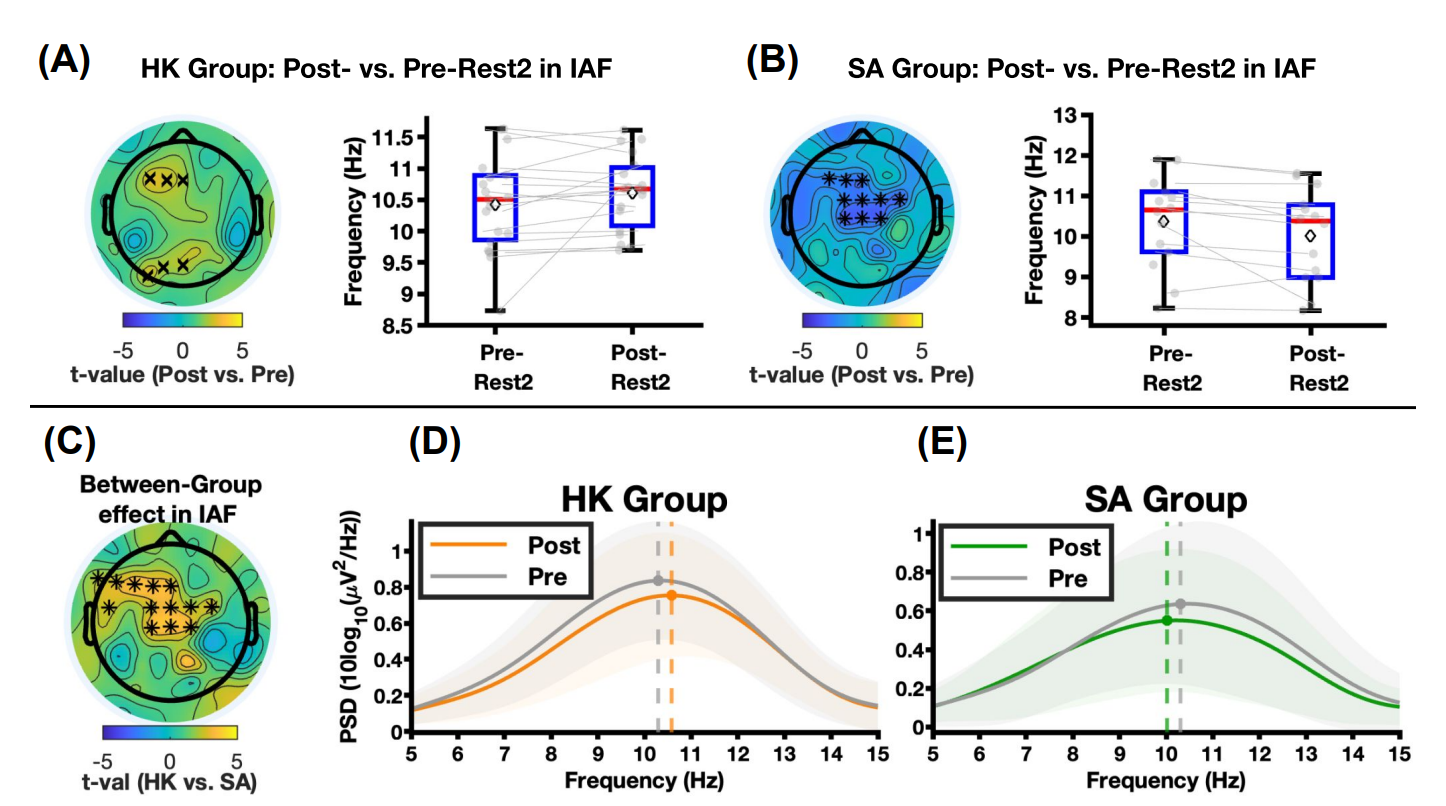
The study of contemplative practices has evolved into a mature field, yet current taxonomies tend to classify all mantra-based meditation approaches as a single category, overlooking potentially different neural states induced by different mantras or different instructions. To address this gap, we conducted a study of 50 novice subjects practicing two types of mantra-based meditation over a six week period to evaluate changes in Electroencephalography (EEG) during and after meditation. Participants were randomly assigned to meditating with the Hare Krishna (HK) and Sa-Ta-Na-Ma (SA) mantras. Using spectral parameterization, we assessed the effects of each type of meditation on individual alpha power (IAP), individual alpha frequency (IAF) and center of gravity (CoG). The results revealed marked differences in alpha dynamics between the two practices. On the one hand, the HK group exhibited widespread IAP decrease and an IAF/CoG increase during mantra meditation that was maintained during rest after the meditation, which became more pronounced after training in the HK meditation. On the other hand, the SA group showed a localized IAP reduction during meditation and significant reduction of IAF during meditation after training. We suggest that the higher cognitive demands of HK induce a more activating, attentionally focused state, whereas SA promotes a more relaxed state. Additional psychological data show that both meditation groups had reduction in stress. Thus, these findings challenge the monolithic classification of mantra meditation and highlight the importance of differentiating practices according to their mechanisms, particularly for their targeted application in mental health contexts.
References
A. Li, J. Rodriguez-Larios, M. Zhang, T. Liu, B. H. Cohen, and S. Ravishankar, "Not all mantra meditations are equal: Emergence of divergent alpha oscillatory dynamics across mantras. "(bioRxiv 2026)
L-FAME Dataset and Benchmark
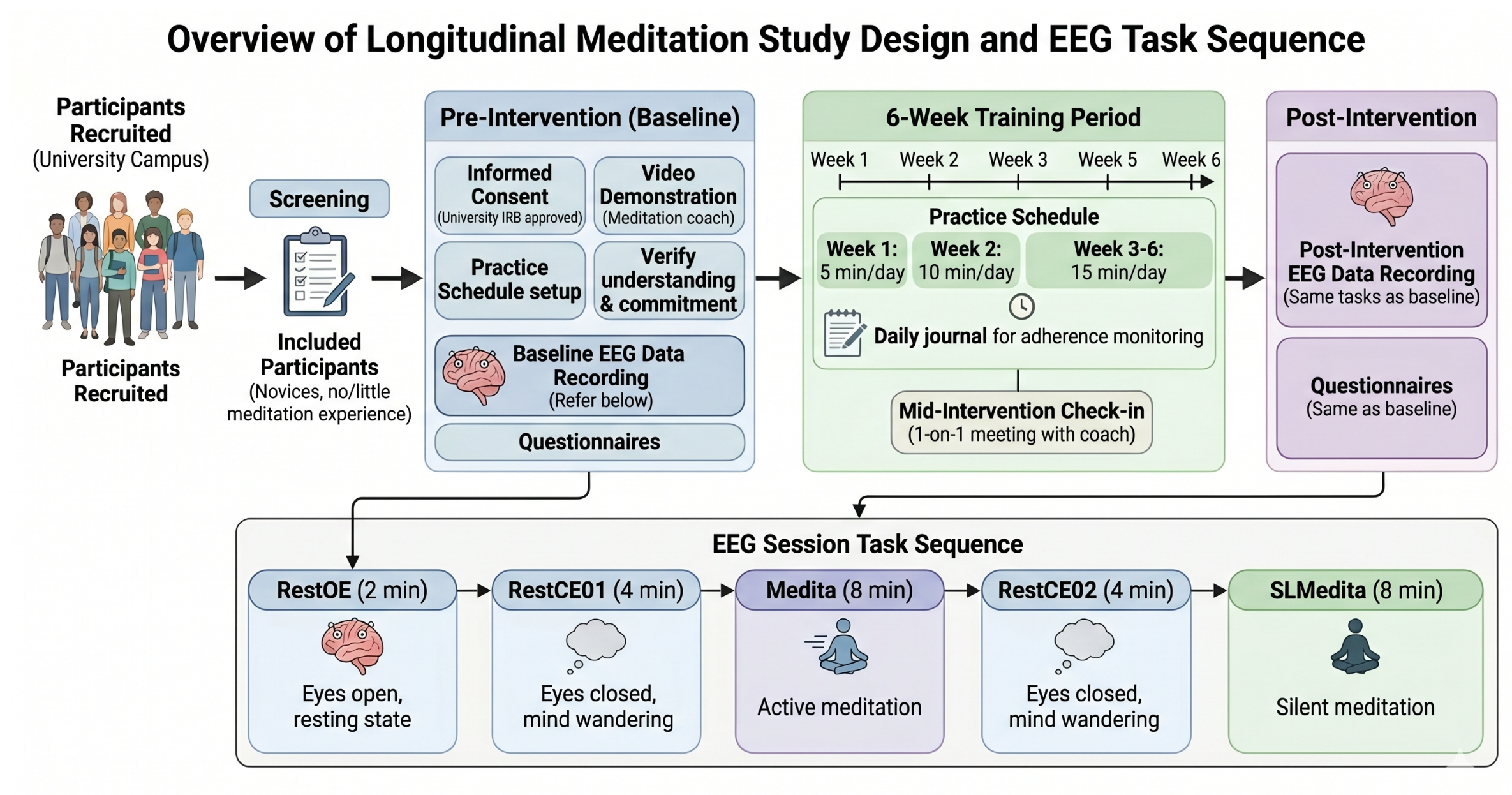
We introduce a novel Longitudinal Focused Attention Meditation Electroencephalography (L-FAME) dataset and an accompanying benchmark, designed to foster research into the neural effects of various meditation practices and the evolution of these effects over a six-week training period. The dataset contains EEG recordings and psychological assessments from 74 healthy college participants, collected at two distinct time points: pre-intervention and post-intervention. Participants were randomly assigned to one of three distinct meditation groups: two mantra-based techniques (SA-TA-NA-MA and Hare Krishna) and one Breath Focus practice. Leveraging this unique longitudinal and comparative dataset, we propose a benchmark suite comprising three distinct classification tasks: (1) cognitive state decoding to distinguish between resting and meditation states, (2) fine-grained classification of the specific meditation techniques, and (3) cross-session adaptation to evaluate model generalization across the longitudinal time gap. We provide comprehensive baseline results for these tasks utilizing a range of classical machine learning algorithms and deep learning architectures. The complete dataset, preprocessing pipelines, and benchmark evaluation code will be publicly released, offering a valuable resource and a standardized framework for the development and comparison of new analytical methods in computational meditation research and EEG-based machine learning.
Data here
References
A. Li, A. B. R. Syed, H. Alzweri, T. Liu, B. H. Cohen, and S. Ravishankar, "L-FAME: Longitudinal Focused Attention Meditation EEG Dataset and Benchmark." (arXiv 2026)